Bonus Lecture: It’s the End of the World as We Know It; Arthur Dent Feels Fine
Curiously enough, the only thing that went through the mind of the bowl of petunias as it fell was Oh no, not again.
Douglas Adams, The Hitchhiker's Guide to the Galaxy
Douglas Noel Adams (1952–2001)
Adams at UCSB Arts & Lectures, 2001
- Educated at Cambridge; wrote for the BBC, particularly radio dramas (but notably including TV material for Dr. Who and Monty Python).
- Best known for the Hitchhiker’s Guide series.
- Died in Santa Barbara in 2001.
And what’s happened to the Earth?
Ah. It’s been demolished.
Has it,
said Arthur levelly.
Yes. It just boiled away into space.
Look,
said Arthur, I’m a bit upset about that.
Ford frowned to himself and seemed to roll the thought around his mind.
Yes, I can understand that,
he said at last.
Understand that!
shouted Arthur. Understand that!
Ford sprang up.
Keep looking at the book!
he hissed urgently.
What?
Don’t Panic.
I’m not panicking!
Yes, you are.
All right, so I’m panicking, what else is there to do?
(39; ch. 5)
Science Fiction
- A term popularized in the 1940s.
- Some critics now prefer the term
speculative fiction
for the genre. - Other terms have historically been used for the SF genre.
- Like Wyndham's
logical fantasy
.
- Like Wyndham's
- Some critics now prefer the term
- Generally seen as growing out of the 19th century Gothic novel and made possible (and relevant) by increased 19th century scientism and mass literacy.
- Also tends to draw on the traditions of utopian/dystopian and didactic literature.
- Is generally rationalist and (at least historically) progressivist in its approaches.
- Tends to see the short story as its essential form, and to structure plots around the problem/resolution pattern.
- Often depends on an effect of extreme estrangement for its organization and driving force.
It is an important and popular fact that things are not always what they seem.
(105; ch. 23)
These things will become clearer to you,’ said the only man gently,
at least, he added with slight doubt in his voice,
clearer than they are at the moment.’
(107; ch. 24)
As soon as Mr. Prosser realized that he was substantially the loser after all, it was as if a weight lifted itself off his shoulders: this was more like the world as he knew it.
(15; ch. 1)
The History of Science Fiction
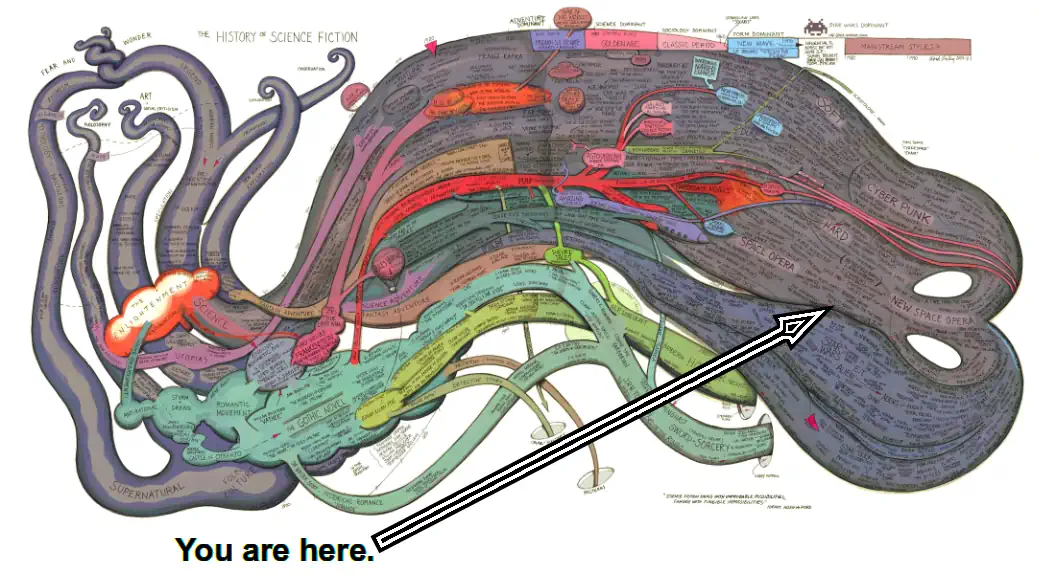
Based on a painting by Ward Shelley.

The space opera
SF tradition
- A specific subgenre in SF, whose name is a variation not on a musical theme, but on the phrase
soap opera.
- Usually involves melodramatic conflicts between opponents possessing advanced techonology.
- Settings, battles, characters are very, very large in scale.
- An example with which you are almost certainly familiar: the Star Wars movies.
Satire
- There are two primary forms of satire:
- Formal or direct satire: The narrator directly addresses the reader with explicit comments about the subject being satirized.
- Indirect satire: Most common form in plays and novels; the author presents a situation and allows the reader (or viewer of a play) to draw his/her own conclusions.
- Satire can occur in novels, poetry, drama, and other literary and quasiliterary forms.
- The word
satire
refers to both:- (in general) the act of exposing a situation to ridicule; and
- (specifically) a literary form that is primarily concerned with performing this ridicule.
- The 17th and 18th centuries are sometimes referred to as the
Age of Satire
in English literature.- Major practitioners in this period include Alexander Pope and Jonathan Swift.
- Most 17th- and 18th-century satirists explicitly model their satires on Latin models, especially Horace and Juvenal.
- Satire can range in tone from gentle chiding to bitter excoriation.
- Historically, satire has generally tended toward didacticism.
- In order to criticize the follies of individuals or social groups, satire requires that its readers share a particular moral viewpoint with the author.
- This is especially true for indirect satire.
- Hence, the satirist, in and by writing satire, elevates and promotes him- or herself as an authoritative judge of morality.
- Satirists often take the position of being
humanistic in spirit,
loving their fellow human beings and wanting to reform those who commit evil and folly in order to benefit all. - British poet W.H. Auden takes a very traditional view of satire:
Satire is angry and optimistic; it believes that, once people's attention is drawn to some evil, they will mend their ways.
Forward to Angus Stewart’s Sense and Inconsequence (1972)
An example: bureaucracy
by lunchtime life in the environs of Arthur’s house had settled into a steady routine. It was Arthur’s accepted role to lie squelching in the mud making occasional demands to see his lawyer, his mother or a good book; it was Mr. Prosser’s accepted role to tackle Arthur with the occasional new ploy such as the For the Public Good talk, or the March of Progress talk, the They Knocked My House Down Once You Know, Never Looked Back talk and various other cajoleries and threats.
(12; ch. 1)
This is Prostetnic Vogon Jeltz of the Galactic Hyperspace Planning Council […] As you will no doubt be aware, the plans for development of the outlying regions of the Galaxy require the building of a hyperspatial express route through your star system, and regrettably your planet is one of those scheduled for demolition.
(26; ch. 3)
Satire of SF Icons
Because Ford never learned to say his original name, his father eventually died of shame, which is still a terminal disease in some parts of the Galaxy. The other kids at school nicknamed him Ix, which in the language of Betelgeuse Five translates as
boy who is not able satisfactorily to explain what a Hrung is, nor why it should choose to collapse on Betegeuse Seven.’
(Hitchhiker’s Guide 34; ch. 5)
Muad’Dib’s religion had another name now; it was Shien-san-Shao, an Ixian label which designated the intensity and insanity of those who thought they could bring the universe to paradise at the point of a crysknife. But that too would change as Ix had changed. For they were merely the ninth planet of their sun, and had forgotten the language which had given them their name.
(Frank Herbert, Children of Dune, 282)
Is Muad’Dib’s death to be followed by the moral suicide of all men? Is that the inevitable aftermath of a Messiah?
Then you admit him Messiah!
the voice from the crowd shouted.
Why not, since I’m the prophet of his times?
The Preacher asked. (Children of Dune, 223-24)
I spare not a single unit of thought on these cybernetic simpletons!
he boomed. I speak of none but the computer that is to come after me!
Fook was losing patience. He pushed his notebook aside and muttered, I think this is getting needlessly messianic.
(Hitchhiker’s Guide 113; ch. 25)
Fascinating trade,
said the old man, and a wistful look came into his eyes, doing the coastlines was always my favorite. Used to have endless fun doing the little bits in fjords … so anyway,
he said, trying to find his thread again, the recession came and we decided it would save a lot of bother if we just slept through it. So we programmed the computers to revive us when it was all over.
The man stifled a very slight yawn and continued.
The computers were index-linked to the Galactic stock-market prices, you see, so that we’d all be revived when everybody else had rebuilt the economy enough to afford our rather expensive services.
Arthur, a regular Guardian reader, was deeply shocked at this.
That’s a pretty unpleasant way to behave, isn’t it?
Is it?
asked the old man mildly. I’m sorry, I’m a bit out of touch.
He pointed down into the crater.
Is that robot yours?
he said.
No,
came a thin metallic voice from the crater, I’m mine.
(102-03, ch. 22)