Lecture 13: Endless quantities of the Real
*
Winter 2013
Of course it is happening inside your head, Harry, but why on earth should that mean that it is not real?
Albus Dumbledore in Harry Potter and the Deathly Hallows, ch. 35.
* Rem Koolhaas, Junkspace,
p. 189
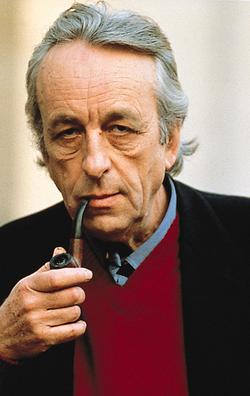
Louis Althusser (1918-1990)
- Held prisoner by the Third Reich for five years before entering the prestigious École Normale Supérieure.
- Commonly referred to as a
structuralist Marxist,
though he was critical of both the PCF and the structuralist movement. - Best known for Reading Capital and For Marx (both 1965).

Althusser's first thesis
Ideology represents the imaginary relationships of individuals to their real conditions of existence.
(1264)- For those who are external to an ideological practice, it seems that an ideology is a false
world outlook,
and therefore needs to beinterpreted
toget at
reality. - Althusser notes:
ideology=illusion/allusion.
- For those who are external to an ideological practice, it seems that an ideology is a false
What is represented in ideology is therefore not the system of the real relations which govern the existence of individuals, but the imaginary relation of those individuals to the real relations in which they live.
(1265)
Althusser’s second thesis
Ideology has a material existence.
(1265)- Ideology is not (only) a set of ideas that then have real-world implications, but is, rather, inscribed in a set of practices.
- Althusser’s primary example: the Christian (≅Catholic, for this particular Frenchman) ideology is not merely a set of beliefs, but the practice of attending Mass, receiving the sacraments, kneeling to pray, etc. (1266)
- Other examples are provided on 1269.
- Everyone is obliged to act according to his/her beliefs.
If he does not do so,
and implies ideas contrary to those that the individual professes. (1266-67)that is wicked
actions inserted into practices […] governed by the rituals in which these practices are inscribed, within the material existence of an ideological apparatus.
(1267)
- Ideology is not (only) a set of ideas that then have real-world implications, but is, rather, inscribed in a set of practices.
Some implications
There is no practice except by and in an ideology.
There is no ideology except by the subject and for subjects.
(1268)- One of the primary functions of ideology is to constitute subjects as subjects. (Althusser sketches out a quick history of the idea of
the subject,
noting that it goes by different names in different ideological systems.)
- One of the primary functions of ideology is to constitute subjects as subjects. (Althusser sketches out a quick history of the idea of
- More specifically, ideology has the function of producing subjects who live
spontaneously
within the bounds sketched out by the ideology.
The elementary ideological effect
As St. Paul admirably puts it, it is in the
(p. 1268)Logos,meaning in ideology, that welive, move, and have our being.It follows that, for you and for me, the category of the subject is a primaryobviousness(obviousnesses are always primary); it is clear that you and I are subjects (free, ethical, etc. …). Like all obviousnesses, including those that make a wordname a thingorhave a meaning(therefore including the obviousness of thetransparencyof language), theobviousnessthat you and I are subjects – and that that does not cause any problems – is an ideological effect, the elementary ideological effect. It is indeed a peculiarity of ideology that it imposes (without appearing to do so, since these areobviousnesses) obviousnesses as obviousnesses, which we cannot fail to recognize and before which we have the inevitable and natural reaction of crying out (aloud or in thestill, small voice of conscience):That’s obvious! That’s right! That’s true!
Let us summarize …
… what we have discovered about ideology in general.
- The duplicate mirror-structure of ideology ensures simultaneously:
- the interpellation of
individuals
as subjects. - their subjection to the Subject;
- the mutual recognition of subjects and Subject, the subjects’ recognition of each other, and finally the subject’s recognition of himself;
- the absolute guarantee that everything really is so, and that on condition that the subjects recognize what they are and behave accordingly, everything will be all right: Amen –
So be it.
(1271)
- the interpellation of
Blindness and ideology
Pay attention, I’m going to switch off the light and you can tell me, now, Nothing, What do you mean nothing, Nothing, I always see the same white, it’s as if there were no night.
(9; ch. 1)Perhaps only in a world of the blind will things be what they truly are, said the doctor.
(126; ch. 8)He [the guard at the third ward] had been waiting for ages for one of his comrades to come and relieve him, but for this to happen it was necessary that the other, on hearing the inner voice of duty, should wake up by himself.
(157; ch. 10)
Identity and blindness
Were we not trying to reduce her [the girl with the dark glasses] to some primary definition, we should finally say of her, in the broad sense, that she lives as she pleases and moreover gets all the pleasure she can from life.
(23; ch. 2)he [the doctor] simply stretched out his hands to touch the glass, he knew that his image was there watching him, his image could see him, he could not see his image.
(29; ch. 3)dear God, how we miss having our sight, to be able to see, to see, even if they were only faint shadows, to stand before the mirror, see a dark diffused patch and be able to say, That’s my face.
(69; ch. 5)
our names, what do names matter
*
it seemed he was about to give his name, but what he said was, I’m a policeman, and the doctor’s wife thought to herself, He didn’t give his name, he too knows that names are of no importance here.
(59; ch. 5)No one seemed interested in knowing who had died.
(87; ch. 6)Who is speaking, asked the doctor, A blind man, replied a voice, just a blind man, for that is all we have here.
(129; ch. 8)
* 58; ch. 5
many ways of becoming an animal
*
any day now, we shall no longer know who we are, or even remember our names, and besides, what use would names be to us, no dog recognizes another dog or knows the others by the names they have been given, a dog is identified by its scent and that is how it identifies others, here we are like another breed of dogs.
(57; ch. 5)Someone protested at the far end of the ward. Pigs, they’re like pigs.
(93; ch. 6)Thieving dogs, that’s what they are, commented a rough voice.
(105; ch. 7)- The doctor’s wife:
If we cannot live entirely like human beings, at least let us do everything in our power not to live entirely like animals.
(116; ch. 8)
* 93, ch. 6
Blindness = [X]
constructions ...
- … are never given in the novel. We are never told,
interpret blindness allegorically in this way.
- However, there are a number of partial constructions that move in the other direction, of the form
[X] is [also] blindness
:who can say that this white blindness is not some spiritual malaise
(85; ch. 6)to be dead is to be blind
(108; ch. 7)we were already blind the moment we turned blind, fear struck us blind, fear will keep us blind.
(129; ch. 8)
- The rapists in the third ward are
blinded by lust.
(167; ch. 11) - The doctor’s wife:
Perhaps I’m the blindest of all, I’ve already killed and I’ll kill again if I have to.
(191; ch. 12) The blind are always at war, always have been at war, Will you kill again, If I have to, I shall never be free from this blindness.
(193; ch. 12)in death, blindness is the same for all.
(210; ch. 12)
The doctor’s wife comes to realize that continuing to counterfeit blindness is pointless:
blindness is also this, to live in a world where all hope is gone.
(209; ch. 12)
we ought to start getting organised without delay
*
- The recorded announcement:
the internees must organize themselves as the see fit
(43; ch. 4) The blind moved as one would expect of the blind, groping their way, stumbling, dragging their feet, yet as if organised, they knew how to distribute tasks efficiently.
(86; ch. 6)Unless we organise ourselves in earnest, hunger and fear will take over here.
(91; ch. 6)
* the doctor, on p. 45; ch. 4
They [the occupants of the third ward]’re organized, he [the doctor] thought to himself, this has not suddenly been improvised.
(145; ch. 9)are we agreed that the hand that stabbed him was the hand of all of us, or to be more precise, the hand of each one of us. No one replied.
(197; ch. 12)In this place, age is of no account, nor sex, therefore don’t forget the women.
(203; ch. 12)And how can a society of blind people organise itself in order to survive, By organising itself, to organise oneself is, in a way, to begin to have eyes
(296; ch. 16)
A preliminary and a final thought
Faltering, as if his lack of sight had weakened his memory, the [first] blind man gave his address, then he said, I have no words to thank you, and the other replied, Now then, don’t give it another thought, today it’s your turn, tomorrow it will be mine, we never know what might lie in store for us.
Saramago 3; ch. 1
Inside us there is something that has no name, that something is what we are.
The girl with the dark glasses on 276 (ch. 15)
Media credits
- The photo of Louis Althusser (slide 2) is from Wikipedia. Wikipedia’s rationale for the use of that photo, which I believe also applies to my use here, is:
- Fair use is claimed because there is no free-license equivalent, the image is widely available and has no commercial value, and is being used for educational purposes to illustrate an article about the subject.
