Lecture 5: The Enchainment of Past and Future
English 140
Summer Session B, 2012
UC Santa Barbara
Summer Session B, 2012
UC Santa Barbara
We also insist that politics demands complex thinking and that poetry is an arena for such thinking: a place to explore the constitution of meaning, of self, of groups, of nations,—of value.
Charles Bernstein,Revenge of the Poet-Critic(1999)
Some poetic terminology ...
Had we but world enough, and time,
This coyness, lady, were no crime.
We would sit down, and think which way
To walk, and pass our long love's day.
Thou by the Indian Ganges’ side
Shoudst rubies find; I by the tide
Of Humber would complain. I would
Love you ten years before the flood,
And you should, if you please, refuse
Till the conversion of the Jews.
– Andrew Marvell,
To His Coy Mistress(1651?)
The poem’s epigraph
τοῦ λόγου δὲ ἐόντος ξυνοῦ ζώουσιν οἱ πολλοί
ὡς ἰδίαν ἔχοντες φρόνησιν
(Though wisdom is common, the many live as if they have wisdom of their own.
)
ὁδὸς ἄνω κάτω μία καὶ ὡυτή
(The way upward and the way downward are one and the same.
)
— Ἡράκλειτος ὁ Ἐφέσιος (Heraclitos of Ephesus)
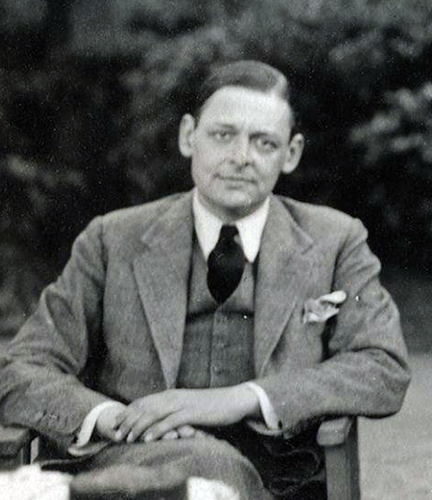
Thomas Stearns Eliot (1888–1965)
- American expatriate who stayed in England after spending time there as a student during WWI.
- Probably best known for
The Love Song of J. Alfred Prufrock
(1915) and The Waste Land (1922). - Nobel Prize for Literature (1948), Order of Merit (1948), Tony Award (1950 and twice in 1983), Legion of Honor (1951), Presidential Medal of Freedom (1964).

The Four Quartets
- Originally published separately as
Burnt Norton
(1936),East Coker
(1940),The Dry Salvages
(1941), andLittle Gidding
(1942). First collected in 1943. - In music, a
quartet
is a way of arranging four instruments or voices so as to produce melodious harmonies.- Eliot uses the
quartet
as a metaphor for the structure of the poems to highlight the way that various tonal and metaphoric strands interact in each poem.
- Eliot uses the
- Each poem also connects back to previous poems in the series by revisiting themes and employing similar devices.
Note that
Burnt Nortonboth begins and ends with a meditation on time:
Time present and time past
Are both perhaps present in time future;
And time future contained in time past.
If all time is eternally present
All time is unredeemable. (117; lines 1-5)
Are both perhaps present in time future;
And time future contained in time past.
If all time is eternally present
All time is unredeemable. (117; lines 1-5)
[……………………………………………]
Ridiculous the waste sad time
Stretching before and after. (122; lines 174-5)
Stretching before and after. (122; lines 174-5)
- The poem contains many philosophical and religious meditations about time.
Each of the Quartets has a similar five-part structure:
- Scenes of action and movement, combined with meditations on time, with fleeting glimpses of timelessness. (A comparatively long section.)
- An episode of dissatisfaction with worldly experience. (A comparatively long section.)
- Purgation in the world, divesting the soul of the love of created things. (A comparatively long section.)
- A lyric prayer for, or affirmation of the need of, Intercession. (A short section; usually an emotional, self-contained lyric, sometimes associated in some way with Mary, mother of Jesus.)
- The problems of attaining artistic wholeness and, at the same time, the problems of achieving spiritual health. (Normally a rhetorically elevated restatement of the poem's themes with a conclusion. A comparatively long section.)
Media credits
- The photo of T.S. Eliot on slide 5 was taken in 1934 by Lady Ottoline Morrell. Its copyright has expired. (Source.)